Lovable vs Replit Once You Have Real Users
People ask “Lovable vs Replit” as if they were two brands of the same thing. They aren’t. Lovable is a chat window that writes a React app and wires it to a Postgres backend for you. Replit is a full cloud computer with an AI agent sitting inside it. Both will build you a working app from a prompt. They split apart the day your app needs something the prompt didn’t mention.
I’ll skip the feature checklist. Here’s how each one behaves once you have real users, because that’s when the choice starts costing money.
What you’re actually getting
Lovable gives you one shape of app: a React front end (TanStack Start for projects made since May 2026, React with Vite before that) and a backend on Lovable Cloud, which is Supabase under the hood. Database, auth, file storage and edge functions all come from there. You talk, it edits, you publish to a lovable.app address or your own domain. The code syncs to GitHub if you connect it.
Replit gives you a workspace that runs almost anything: Node, Python, Go, a Discord bot, a cron job that scrapes prices at 3 a.m. Its Agent builds the app, but underneath is a real Linux container with a shell, a package manager and a Postgres database. You publish it as an autoscale deployment (sleeps when nobody’s using it), a reserved VM (always on), a static site, or a scheduled job.
That difference sounds academic until you need a long-running process. Lovable’s backend is Supabase edge functions: short-lived, request-in, response-out. A websocket server that holds 200 connections, a worker that chews through a video queue, a Python library your data person swears by: none of that fits Lovable’s model without bolting on another host. Replit just runs it.
How each one bills you
Both moved to usage pricing, and both are easy to underestimate.
Lovable, from its own docs as of mid-October 2026: Pro is $25 a month for 100 credits and $50 for 200, Business starts at $50. You also get 5 daily build credits and a monthly grant of 20 Cloud credits. Building eats credits per message (Plan Mode is 1 credit a message, normal edits vary by how big the change is). Running the app eats Cloud credits for the database, storage and email. Run out and the backend can pause.
Replit, from its pricing page and billing docs checked today: Core is $20 a month ($18 billed yearly) and includes $20 of usage, Pro is $100. The Agent bills by effort, one checkpoint per request, with no fixed price per checkpoint. Hosting is metered separately, using the prices that took effect August 1, 2026:
- Autoscale: $1 a month base, $0.60 per million compute units, $0.40 per million requests.
- Reserved VM: about $15 a month for a shared 0.5 vCPU / 2 GB box ($0.0208 an hour).
- Postgres: $0.16 per hour of database compute, plus $0.35 per GiB of storage a month.
- Outbound data: $0.05 per GiB.
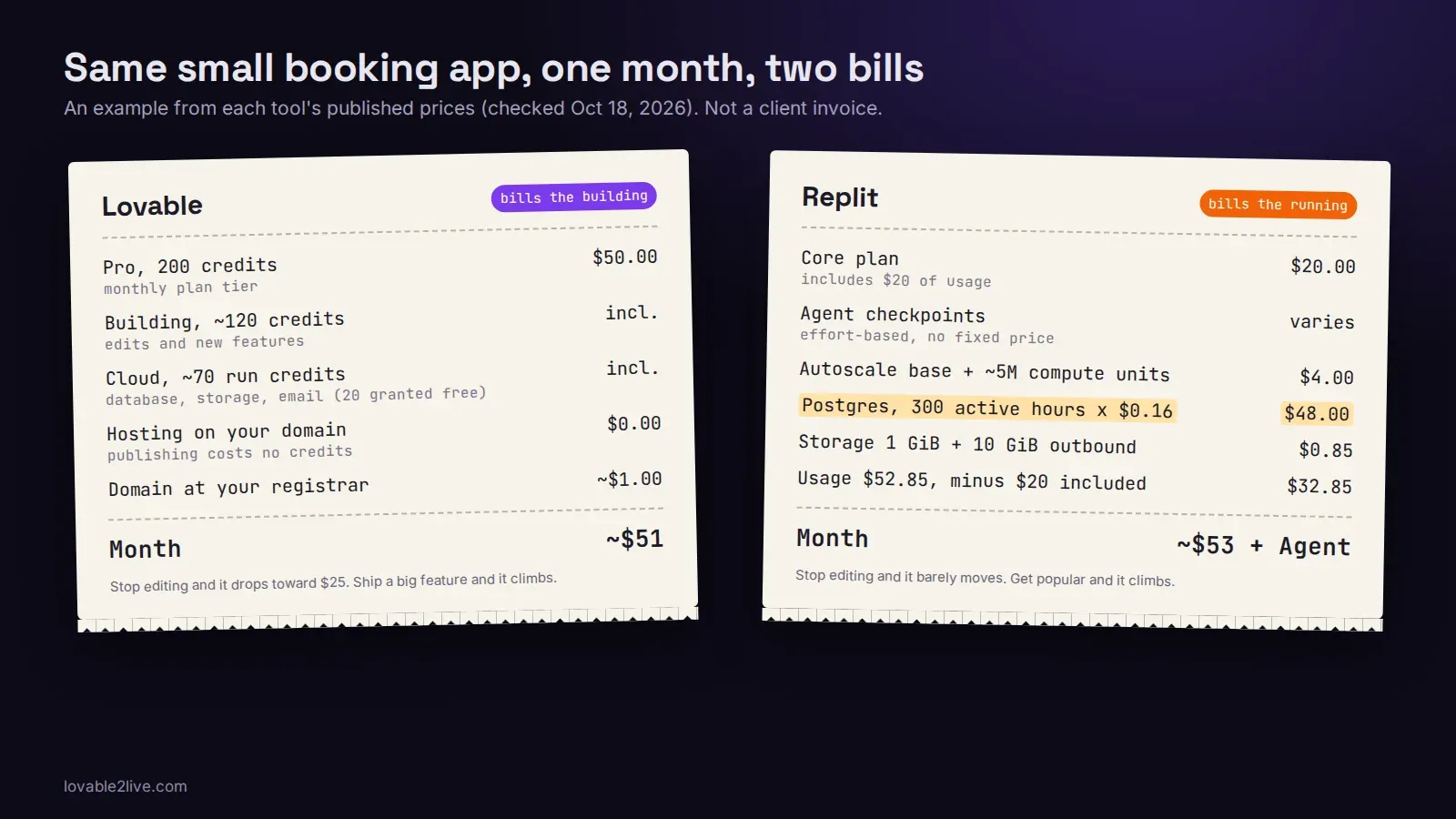
The bill above is a made-up booking app with a few hundred users, not a client invoice. The point is the shape. Lovable’s bill is mostly “how much did you build this month”. Replit’s bill is mostly “how much did your app run this month”. If you stop editing, Lovable gets cheaper. If your app gets popular, Replit gets more expensive, and the Postgres hours are the line that surprises people, because a health check pinging every couple of minutes keeps the database awake. If your app is already on Lovable, our free Lovable cost check reads your repo and prices it on Lovable Cloud and three other setups.
Where each one breaks
Lovable breaks at the edges of its stack. We had a founder last spring with a tidy Lovable app for dog groomers, about 40 paying salons. Then a salon chain asked for a nightly CSV sync from their old booking system. That’s a scheduled job that runs for 20 minutes. Edge functions time out long before that. We moved the job to a small server and left the app in Lovable, which was the right call, but it was a week nobody had planned for.
Replit breaks in the opposite place: it lets the Agent do anything, so it sometimes does. A Replit app is closer to a real codebase, which means real codebase problems. Dependencies drift. The Agent picks an ORM in week one and a different one in week three. You end up with two migration folders and a requirements.txt nobody trusts. I’d rather debug that than a black box, but a non-technical founder usually can’t, and the Agent fixing its own mess costs checkpoints.
Security is the same story both ways. Lovable leans on Supabase row level security, and the default policies are where we find most leaks in audits. Replit apps tend to have hand-rolled auth and secrets sitting in places they shouldn’t. Neither tool makes you safe by itself.
So which one?
Pick Lovable if your app is a web front end over a database: dashboards, booking, marketplaces, internal tools, a SaaS where the hard part is the screens. You’ll move faster, the output is consistent, and the stack (React plus Supabase) is boring in a good way. Any developer can take it over later.
Pick Replit if the core of your product is a process, not a page: bots, scrapers, background workers, anything in Python, anything that has to stay connected. Or if you’re technical enough to read a stack trace and you want the freedom.
What I wouldn’t do is switch because a demo looked better. Moving a Lovable app to Replit means rebuilding the backend you got for free from Supabase. Most “I’ve outgrown Lovable” cases we see are really one missing piece, a job runner, a webhook handler, a proper staging database, that can sit next to the Lovable app instead of replacing it. If your data lives on Lovable Cloud and you want it on infrastructure you control, move Lovable Cloud to your own Supabase first; it’s usually a day or two, not a rewrite.
If you’re stuck between the two with a real app and real users, see what getting it production-ready costs or just tell us what it does.