Claude Code Pricing: What a Month Costs
How much does Claude Code cost? $20 a month on the Pro plan, $100 on Max, $200 on Ultra, or nothing up front if you sign in with an API key and pay per token. That’s from Claude’s pricing page as it stood on November 19, 2026. The free plan doesn’t include Claude Code at all. What a month really costs you depends less on the plan you pick and more on one habit, which I’ll get to, because it’s the reason most of the founders we talk to think they need Max when they don’t.
The plans, with the small print
Pro is $20 billed monthly, or $17 a month if you pay $200 for the year. Claude Code is in it. Your usage resets every 5 hours and every week, and the page doesn’t give you a number of messages, because it depends on the model, how long the chat is and how big the files are.
Max is $100 a month for “5x Pro usage”, and this is the part people miss: it now comes with $100 a month in API credits for building on the Claude Platform. Ultra is $200, gives “10x Pro usage” a week, drops the 5-hour limit for verified accounts, and the API credits go up to $200. If you were going to pay for API calls in your own app anyway, Max is cheaper than it looks.
Team is for 2 to 150 people. A standard seat is $25 billed monthly ($20 annually) and a premium seat is $125 ($100 annually) with five times the standard usage. You can mix them, which is what I’d do: premium for the one person who codes all day with it, standard for everyone else. Enterprise is a $20 seat (annual, 20 seats minimum) plus usage at API rates.
When you hit a limit on a paid plan you can turn on usage credits and keep going, with a monthly spend limit you set yourself. Set the limit. An uncapped card and an agent left running overnight is how people end up writing angry posts.
Paying per token instead
If you log in to Claude Code with a Console account instead of a subscription, you pay for every token at API list price. On November 19 that was $2 per million input tokens and $10 per million output for Sonnet 5.5, and $4 / $20 for Opus 5.5. Cache reads are cheap on both (Sonnet 5.5 is $0.10 a million), and cache reads are most of what Claude Code sends, because it re-sends your whole conversation on every request.
Claude Code’s own cost docs put the average at about $13 per developer per active day, $150 to $250 a month, with 90% of users under $30 on an active day. Those are enterprise teams, so read it as “a full-time developer”. A founder building evenings and weekends usually lands well under that.
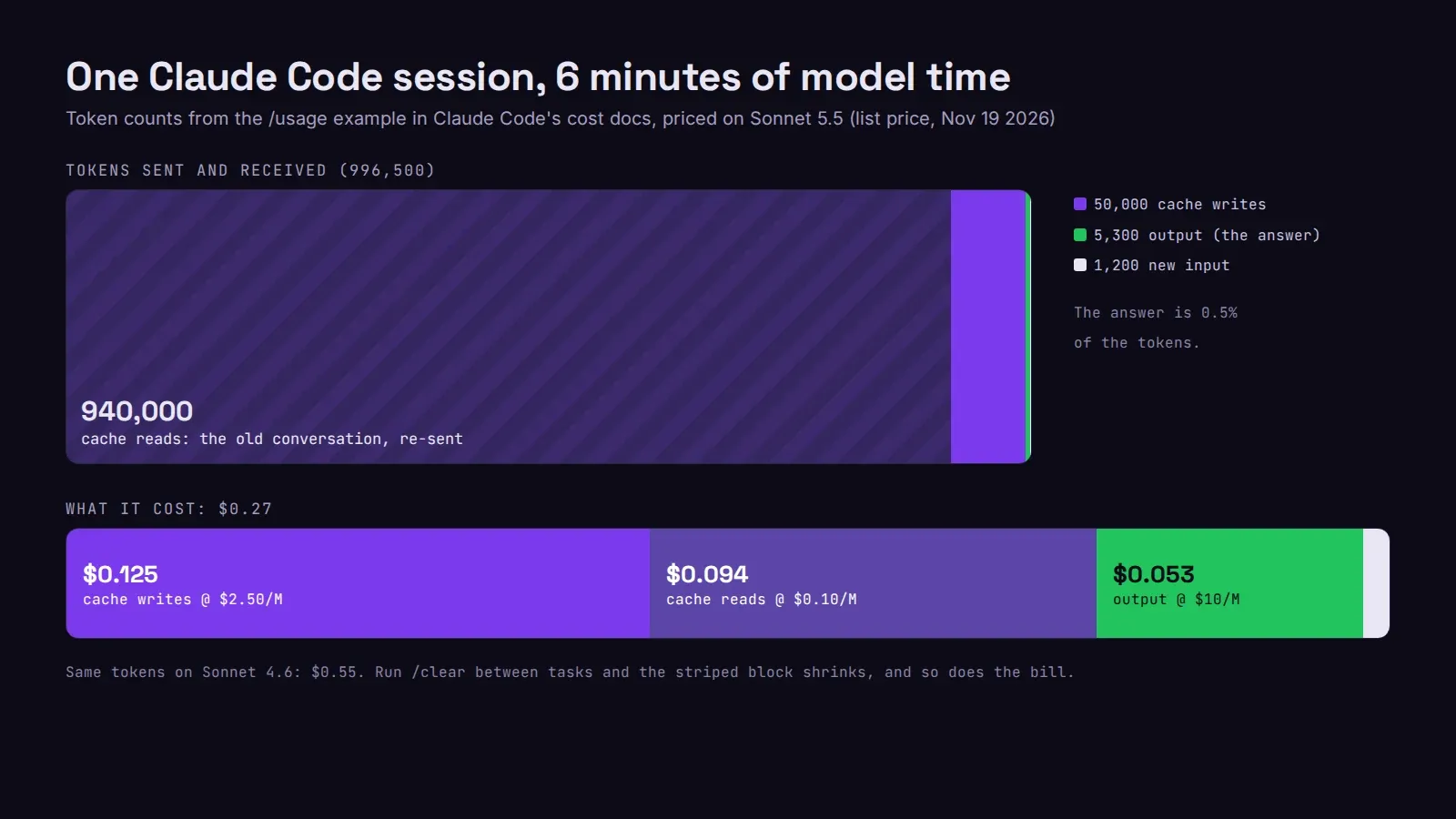
Here’s the session from those docs, the one they show under /usage: 1.2k input tokens, 5.3k output, 940k cache reads and 50k cache writes, on Sonnet 4.6, for $0.55. The same token counts on Sonnet 5.5 come to about $0.27, because the cache-read price fell from $0.30 to $0.10 a million. Look at where the money went, though. 940,000 tokens of cache reads for 5,300 tokens of actual answer. That’s the habit.
What actually eats your limit
It’s the length of the conversation. Every message, every tool call, every test run sends the full history back. A one-line question at 6 pm in a session you opened at 9 am costs you the whole day again.
A founder we work with was on Max and still hitting his weekly wall by Thursday. He had one terminal open per project and never closed them. We looked at /usage together: a CLAUDE.md of about 40k tokens (he had pasted his whole Supabase schema into it, twice), plus four MCP servers he’d installed while following a YouTube video and never used. He went back to Pro the next month. The fixes were boring:
/clearwhen you switch tasks. It costs nothing./compactcosts a big request, because it reads everything it summarizes.- Keep CLAUDE.md short. The docs say under 200 lines. Move long instructions into skills, which only load when used.
- Sonnet by default. Opus for the hard architecture question, then switch back. People leave Opus on for a typo fix.
- Turn off MCP servers you don’t use (
/mcp), and prefer theghorsupabasecommand line over a server that does the same thing. - Plan mode (Shift+Tab) before a big change, so it doesn’t build the wrong thing for twenty minutes.
On a paid plan, /usage now shows which skills, subagents and MCP servers are taking your usage, with suggested fixes. Run it once a week. It’s the cheapest code review you’ll ever get.
So which one?
Start on Pro. Move to Max only after you’ve hit the weekly limit two weeks in a row with short sessions, not long ones. Go API-key only if you’re automating Claude Code in CI or you want hard spend limits per workspace, which the Console does well. If you’re currently paying Lovable credits and wondering whether Claude Code would be cheaper for your app, our free Lovable cost check reads your repo and shows that route next to the others.
The subscription is the small number, anyway. The bigger one is what happens when the AI ships a migration that locks a table with live users on it, or puts a secret key in a client component. That’s the part we do. Our AI build partner setup starts at $600, then from $500 a month we review every pull request the AI writes and own the deploys. If the app is already built and needs to go live properly, we take Claude Code and Cursor apps to production from $500. And if you want a number for the whole project, not just the tool, try the app development cost calculator.