Lovable Alternatives: Which One Fits You
Most lists of Lovable alternatives rank Bolt, v0 and Replit by features, as if you were picking your first app builder. You’re not. You already have an app in Lovable, and something about it annoys you enough to search for a way out. That something decides which alternative makes sense, and for one of the common reasons the honest answer is that you don’t need to leave at all.
So start with why.
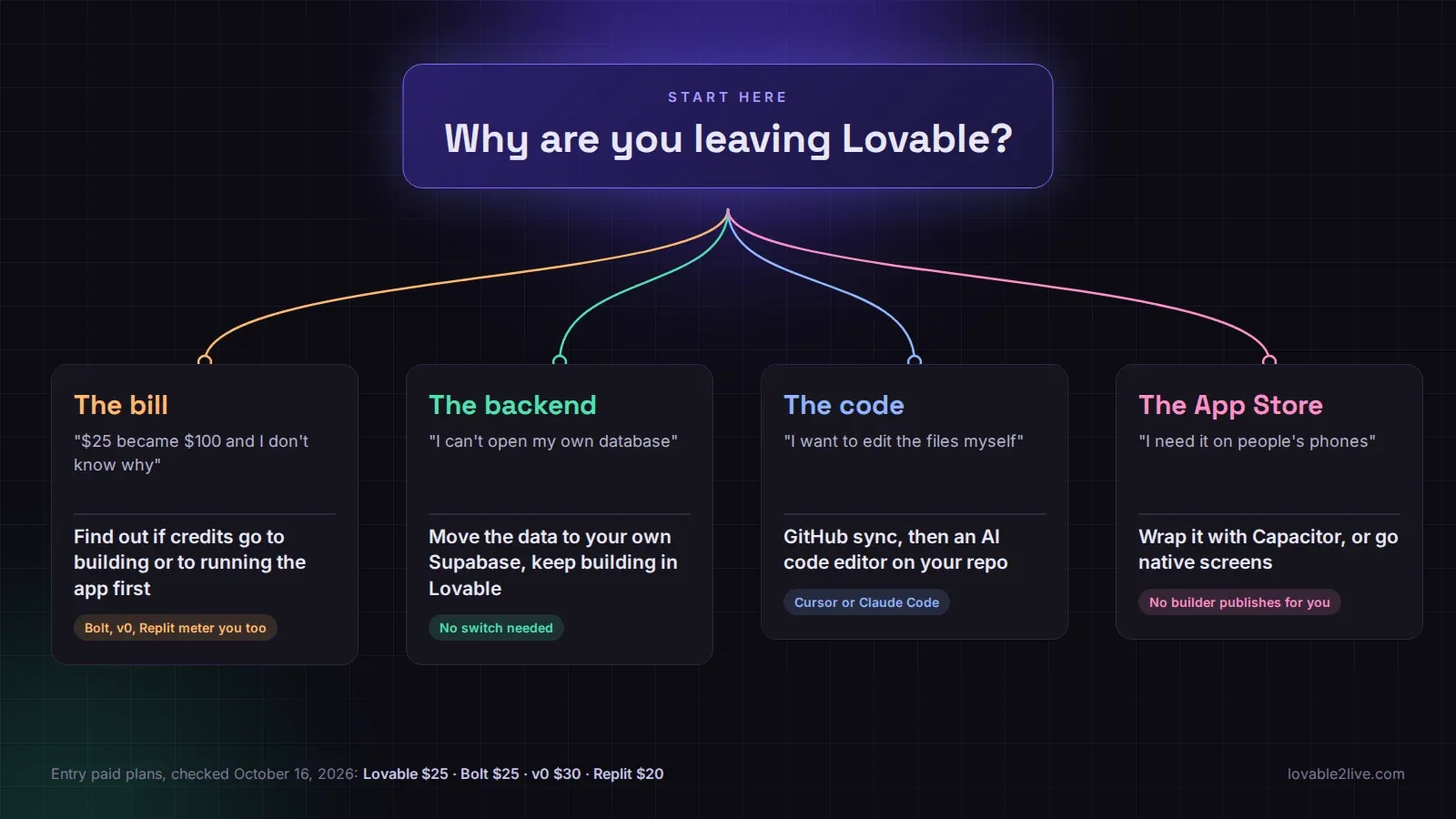
The four reasons people leave
In the calls we get, it’s nearly always one of these:
- The bill. The $25 plan became $50 or $100, and the credits seem to vanish faster than you build.
- The backend. The app runs on Lovable Cloud, so the database, users and files live in a Supabase project you can’t open, and you can’t hand it to anyone.
- The code. You’ve learned enough to want to edit files yourself, or a developer wants to, and the chat box is in the way.
- The phone. You want it in the App Store, and Lovable doesn’t publish there.
If it’s the bill: the other builders meter you too
Here are the paid entry plans as of October 16, 2026, straight from each pricing page:
| Entry paid plan | What you get | What’s metered | |
|---|---|---|---|
| Lovable | Pro, $25/month | 100 credits | building, plus the app’s Cloud and AI usage |
| Bolt | Pro, $25/month | 10M+ tokens, unused ones roll over (up to two months) | tokens per prompt |
| v0 (Vercel) | Plus, $30/month | $30 of credits, plus $2 a day for logging in | credits per message, by model |
| Replit | Core, $20/month ($18 yearly) | $20 of credits | effort per agent task |
They all sell a usage allowance. Bolt’s rollover is genuinely nicer than Lovable’s, and v0 is a good fit if you already live on Vercel. But if you switch to save money, check where your Lovable credits actually go first. For a lot of apps that have real users, the expensive part isn’t building at all. It’s the app running on Lovable Cloud: the database instance, storage, emails and AI calls all come out of the same credit balance. Rebuilding the app in Bolt doesn’t fix that, because now you’re paying for a rebuild and still need somewhere to run a database.
A founder we talked to last month did exactly this. Three weeks in Bolt, the frontend about 80% re-created, then the questions started: where do the 1,400 existing users go, and why do their passwords not work? They came back to Lovable, moved the database to their own Supabase project, and the monthly bill dropped from around $100 to $25 for the database plus the credits they actually used for building. The builder was never the problem.
If it’s the backend: stay in Lovable, change where the data lives
This is the one people get wrong most often. You don’t need a Lovable alternative to own your backend. Lovable works with your own Supabase project, and once the data is there you can open the dashboard, run SQL, add a developer and see real numbers.
The move itself is the fiddly part. Cloud’s export brings the database and users, but storage files, edge function code and secret values have to come separately, and a fresh project needs its permissions checked before the old one goes away. We do that as a fixed-price Cloud to Supabase migration, usually in a day or two, and you keep building in Lovable afterwards exactly as before.
If it’s the code: an AI code editor, not another app builder
When the real wish is “let me edit the files”, Bolt and v0 are a sideways step. They’re still chat-first builders. What you want is a code editor with an agent in it, working on your GitHub repo.
Turn on Lovable’s GitHub sync first so the code is in a repo you own. Then the usual picks are Cursor or Claude Code. Claude Code comes with Claude Pro at $20 a month and works on the repo from a chat, opening pull requests you merge. The trade-off is real: there’s no visual editor, so you check changes on a preview link instead of clicking on the page. People who like that tend to really like it. People who don’t go back to Lovable within a week, and that’s fine too.
You’ll also need hosting for the frontend once it isn’t Lovable’s. Any static host works. It’s an afternoon of work, mostly environment variables.
If it’s the App Store
No web app builder publishes to the stores for you, so switching builders doesn’t help here either. You wrap the app you already have with Capacitor, or rebuild the screens natively when Apple’s review wants more than a web view. That’s its own topic, and we wrote it up on our Lovable to mobile app page.
And if the app has simply outgrown a builder
Sometimes it has: background jobs, a second app sharing the same data, an integration that needs a server. Then no builder is the right answer and you want a developer on the codebase, ideally one who doesn’t make you start over. That’s most of what we do, and the pricing is on the site.
Not sure which reason is yours? Run the free Lovable cost check on your repo. It shows what the same app would cost on four setups, and whether the bill is building or running.