Lovable App Builder: What It Generates in 2026
The Lovable app builder turns a prompt into a working web app, and in late 2026 that app is no longer the simple React page it used to be. New projects start from a template called tanstack_start_ts_current: a server-rendered TanStack Start app with React 19, Vite 8, Tailwind 4 and 46 prebuilt UI components, installed with bun. We know because we made one on October 5, 2026, connected it to GitHub, and read every file.
That matters if you ever plan to host it somewhere else, hand it to a developer, or wonder why a tutorial from last year doesn’t match what you see.
What’s in the repo
Here is the real tree from our test project, the one we use for GitHub sync tests. The first commit is from Lovable itself: template: tanstack_start_ts_current-01a0e63ae988. After that, commits from gpt-engineer-app[bot] for every change made in the editor.
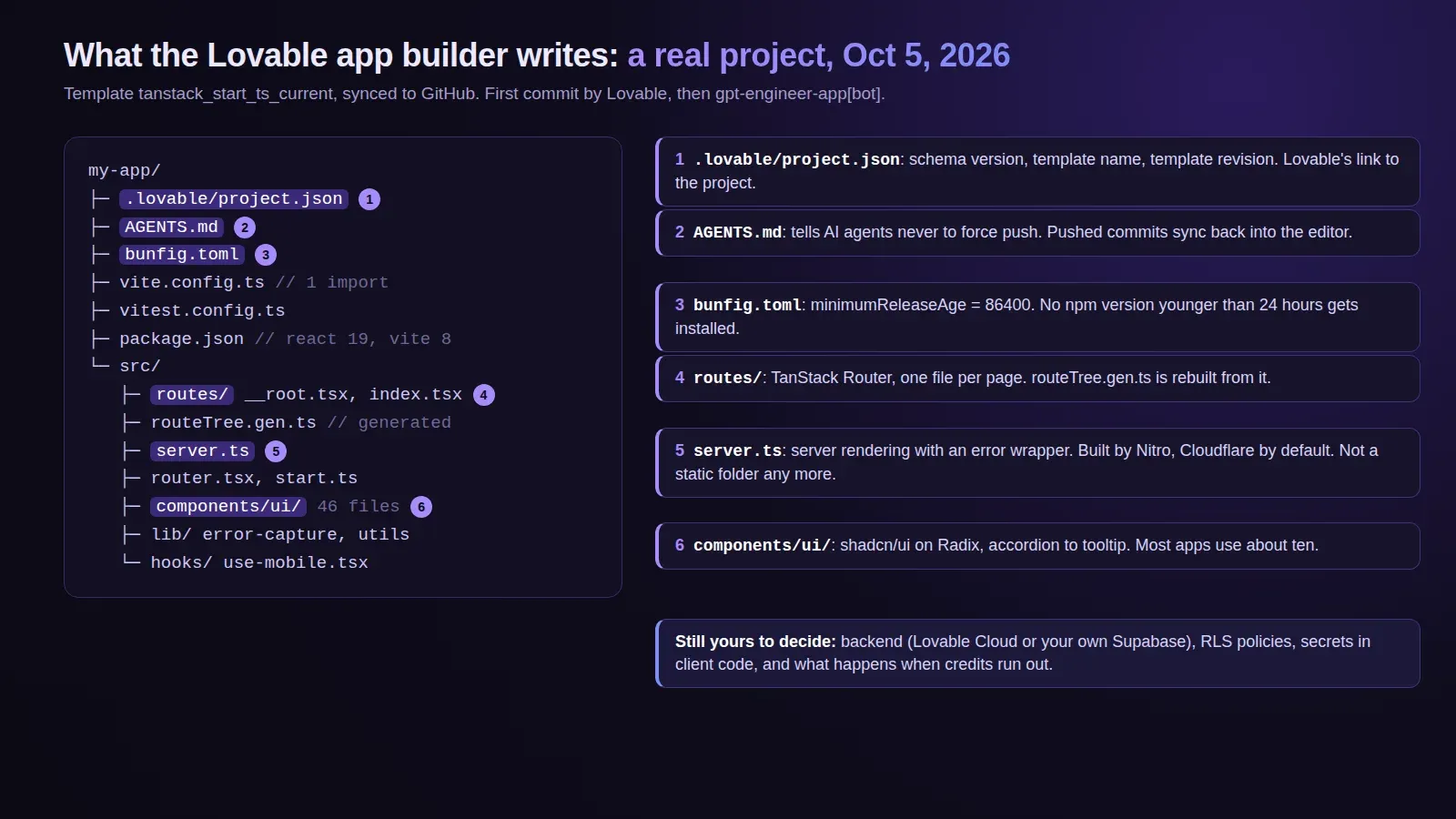
The parts worth knowing about:
.lovable/project.jsonholds three lines: a schema version, the template name and its revision. Don’t delete it.AGENTS.mdis written for AI coding agents, and its first instruction is blunt: don’t force push or rewrite history on the connected branch, because “the user will likely lose their project history.” Commits you push sync back into the Lovable editor, so the branch has to stay in a working state.src/routes/is file-based routing from TanStack Router, androuteTree.gen.tsis generated from it. Don’t edit the generated file by hand, it gets overwritten.src/server.tswraps server rendering so a crash returns a readable error page instead of a bare{"unhandled":true,"message":"HTTPError"}500. Somebody at Lovable got bitten by that and wrote a comment about it.src/components/ui/is shadcn/ui: 46 components, Radix underneath, from accordion to tooltip. Most apps use maybe ten of them.bunfig.tomlrefuses any package version published less than 24 hours ago (minimumReleaseAge = 86400), with exceptions only for Lovable’s own packages. That’s a supply-chain guard against hijacked npm releases, and honestly it’s a better default than most agencies ship.
There’s also Vitest with Testing Library for tests, ESLint and Prettier configs, and a vite.config.ts that is almost empty because everything comes from @lovable.dev/vite-tanstack-config. A comment in that file warns you not to add the TanStack, React or Tailwind plugins yourself “or the app will break with duplicate plugins”. Believe it.
It’s a server app now
Projects from before mid-2026 were single-page apps: Vite built a folder of static files and any static host could serve it. The current template renders pages on a server. The build goes through Nitro, and the config’s default target is Cloudflare.
Two consequences. Google gets real HTML for each page, which is good news for the SEO problems older Lovable apps had. And “just upload the dist folder to Netlify” stops working. We’ve watched a founder do exactly that and get a site that loaded the shell and nothing else, because there was no server to render the routes. You need a host that runs the server build (Cloudflare, Netlify or Vercel with the right Nitro preset, or a Node server), and environment variables have to exist at runtime as well as at build time.
What the builder still leaves to you
The code is clean and the stack is modern. That’s not the problem. What the builder doesn’t decide for you is everything around the code:
- where the backend lives (Lovable Cloud by default, or a Supabase project you own; newer TanStack Start apps can use your own Supabase from the start),
- whether the row level security policies actually stop one user reading another user’s data,
- which secrets ended up in client code,
- what happens to your app when the credits run out.
That last one surprises people. On Lovable Cloud, the backend pauses shortly after your balance hits zero, so sign-in stops working until you top up. Our free Lovable cost check reads your repo and tells you what the app costs to run each month, and what it would cost on your own Supabase.
Should you care which framework it is?
If you only ever build in the editor, barely. If you’ll ever hire a developer, yes: tell them it’s TanStack Start, not Next.js and not a plain Vite SPA, before they quote. Half the estimates we see for “Lovable to production” work are priced for the wrong stack.
When it’s time to take a Lovable app live properly, we do Lovable to production at a fixed price from $500, usually in 5 to 7 days, working in your existing repo so you keep building in Lovable. If the app is on Lovable Cloud and you want the database in your own name, the move to Supabase starts at $150.