Lovable Review: What It's Good and Bad At
Short version of this Lovable review: it’s the fastest way we know to get a working web app in front of people, and it’s a bad place to leave that app once real users and real money depend on it. Both halves of that sentence are true at the same time, which is why most reviews you’ll read are either gushing or furious.
We’re an agency. Almost every app we work on started in Lovable, and the owner hired us because something stopped working. So read this with that bias in mind: we see the apps that hit the wall, not the thousands that were never meant to go further than a demo.
What Lovable is great at
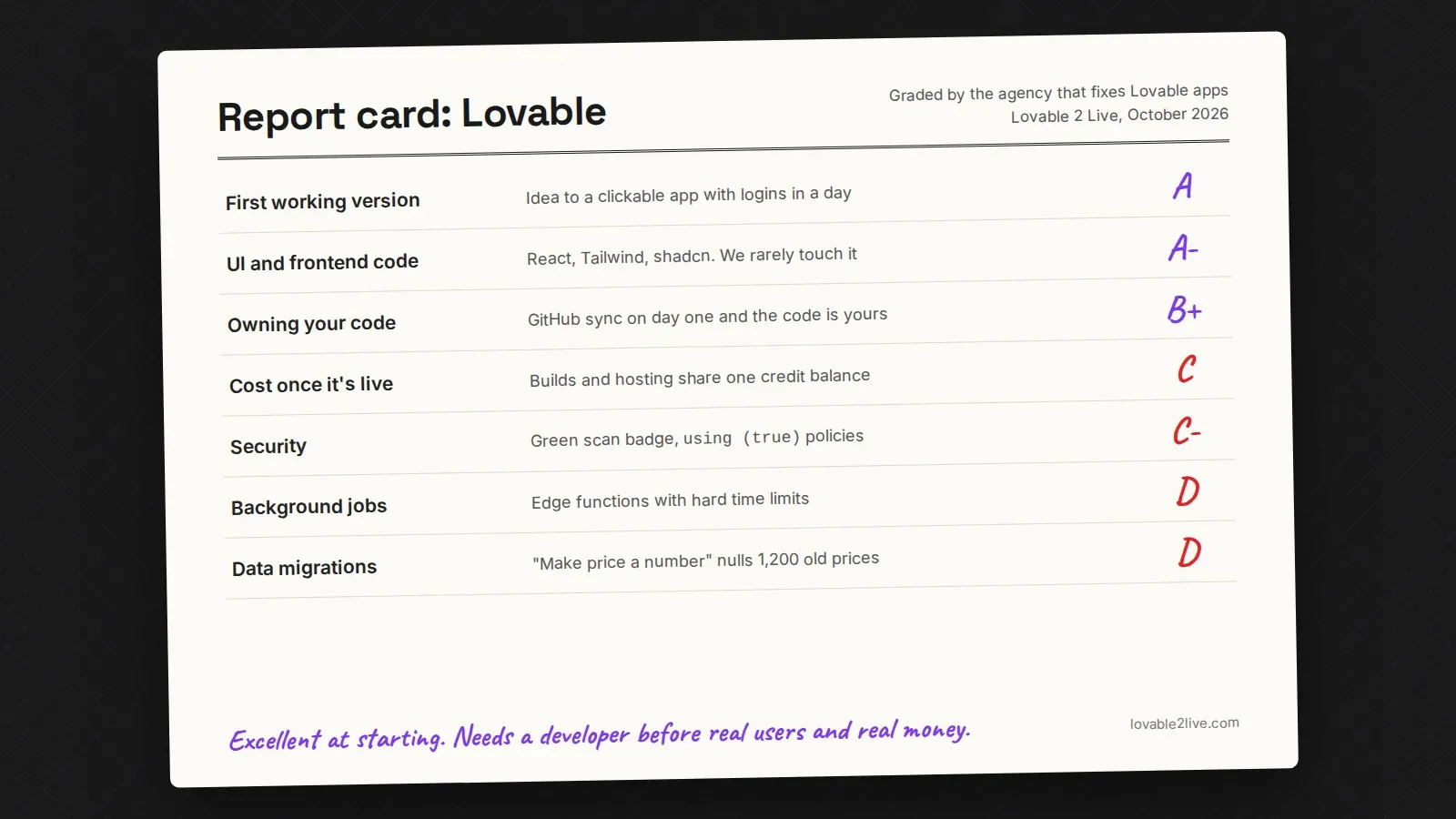
Getting from nothing to a clickable product. A founder with no developer can describe a booking app on Monday and show investors a real one with logins and a database on Tuesday. Two years ago that took a freelancer and three weeks.
The UI it writes is good. Not “good for AI”, actually good: React, Tailwind, shadcn components, sensible spacing. When we take over a Lovable app we almost never touch the frontend layout. We rewrite the data layer and leave the screens alone.
GitHub sync is the feature that makes the rest acceptable. Connect a repo and every change lands as a commit, so the code is yours, a developer can work on it next to you, and you’re never locked in completely. If you take one thing from this review: connect GitHub on day one.
And Lovable Cloud means you don’t have to know what Supabase is. Ask for a login page and you get auth, a Postgres database, storage and edge functions, without opening another dashboard.
Where it breaks
Security that passes the scanner and still leaks. Lovable’s built-in scans have improved a lot this year, but we keep finding row level security policies that are switched on and say using (true), which means every signed-in user can read every row. The badge is green. The data is public. We wrote a whole post on what the security scan won’t catch.
Anything that has to happen when nobody is clicking. Sending a reminder email tomorrow at 9, retrying a failed Stripe webhook, processing a video upload for four minutes. Lovable apps run their backend code in edge functions with hard time limits, and the chat will cheerfully write a “background job” that quietly dies at the limit.
Changes that need a plan instead of a prompt. Renaming a column with 40,000 rows in it, splitting one table into two, changing how money is stored. The AI does the edit, the preview looks fine, and the old rows are now half-migrated. One founder we worked with lost three days of orders to a prompt that said “make price a number instead of text”. It did. The 1,200 existing prices like “$19.99” became null.
Debugging loops. When a fix doesn’t work, you prompt again, it tries something else, you prompt again. Every round spends credits, and past the third or fourth attempt it’s often making things worse. This is the point where most people find us.
What it costs (October 2026)
Pro is $25 a month for 100 credits plus 5 a day, Business is $50 for the same 100 credits plus SSO and team controls, and the free plan gives 5 credits a day up to 30 a month. Since June 1, 2026 the same credits also pay for your live app on Lovable Cloud: database, storage and traffic. When the balance hits zero, the backend pauses shortly after. Your users can’t log in. Our Lovable pricing breakdown has the details.
That’s the part that changes the review for a live app. $25 a month is cheap for a prototype. For an app with paying customers, your hosting bill and your “time spent asking the AI for fixes” bill are now the same balance, and a bad week of debugging can pause production. If you want to see what your own app would cost on Cloud versus your own Supabase or server, the free Lovable cost check reads your repo and shows it side by side.
Who should use Lovable
Founders validating an idea: yes, without hesitation. Internal tools for a team of ten: yes. A marketing site: honestly, yes, just fix the SEO first.
An app that takes payments, stores personal data, or has more than a few hundred active users: start it in Lovable if you like, but plan for a developer to own the backend before launch. Not a rewrite. The frontend is usually fine. It’s the database policies, the secrets, the jobs and the deploy that need a person who reads code.
That’s exactly the work we do. If your app works in preview and you’re nervous about real users, see how we take Lovable apps to production, or if it’s mainly the Cloud bill and the pausing that worry you, our Cloud to Supabase migration is fixed-price from $150.