Lovable Shopify: Who Owns the Store?
Lovable’s Shopify integration builds the storefront in Lovable and keeps the store itself in Shopify. Lovable writes the pages, the cart and the product grid; Shopify holds the products, the inventory, the checkout and the money. A new store starts as a Shopify sandbox that “won’t process real payments”, and it disappears after 30 days unless you claim it.
That last part is the one people miss. Everything below is from Lovable’s Shopify integration docs and Shopify’s US pricing page, both checked on November 8, 2026.
The store you get on day one isn’t a real store yet
When you ask Lovable for a Shopify store and click Create store, it makes a development store at no cost. It reads your country to set the currency, every collaborator gets full read and write access, and you can add products straight from the chat. It looks finished. You can click through to checkout.
It still can’t take money. A founder we helped last spring built a candle shop this way over a weekend, posted the link to about forty Instagram followers on Sunday night, and woke up to three DMs saying the checkout “did nothing”. Nobody had told her the store was a sandbox. Her orders weren’t lost; there were never any orders.
To make it real you type “Claim the store” in the chat and finish the claim on Shopify. That moves the store into your own Shopify account, makes you the owner, and starts a separate 120-day free trial of a Shopify subscription. Then you still have to switch on payments in Shopify Admin and get through Shopify’s KYC check, which the Lovable docs say “may take some time”. Plan for a few days, not a few minutes.
Two clocks run here and they’re easy to mix up:
- 30 days to claim. After that, Shopify deletes the unclaimed store. Lovable only shows you a Close button and you start again with a new store.
- 120 days of trial after you claim. When it ends you need a paid Shopify plan to keep selling.
If you connect a store you already have (Choose store, then Install the Lovable app), none of that applies. Your plan stays as it is.
What it costs once the trial ends
This is Shopify’s bill, not Lovable’s. Lovable says plainly that the subscription is “separate from Lovable pricing”, and its page lists no Shopify prices at all. From Shopify’s US pricing page today:
| Shopify plan | Paid monthly | Paid yearly | Online card rate | Fee if you use another payment provider |
|---|---|---|---|---|
| Basic | $39/mo | $29/mo | 2.9% + 30¢ | 2% |
| Grow | $105/mo | $79/mo | 2.7% + 30¢ | 1% |
| Advanced | $399/mo | $299/mo | 2.5% + 30¢ | 0.6% |
| Plus | from $2,300/mo | 2.25% + 30¢ | 0.2% |
So a small shop on Basic, paid yearly, selling $3,000 a month in $30 orders, pays Shopify about $29 plus roughly $117 in card fees. Then add your Lovable plan on top, because the storefront lives there: the Lovable credits you spend editing it, and the hosting on lovable.app or your own domain. Our Lovable cost check adds up the Lovable side for a real repo.
The 2% line deserves a look. If you take payments through Stripe or PayPal directly instead of Shopify Payments, Shopify adds 2% on Basic on top of what that provider charges. On $3,000 a month that’s $60 for nothing.
Who owns which part
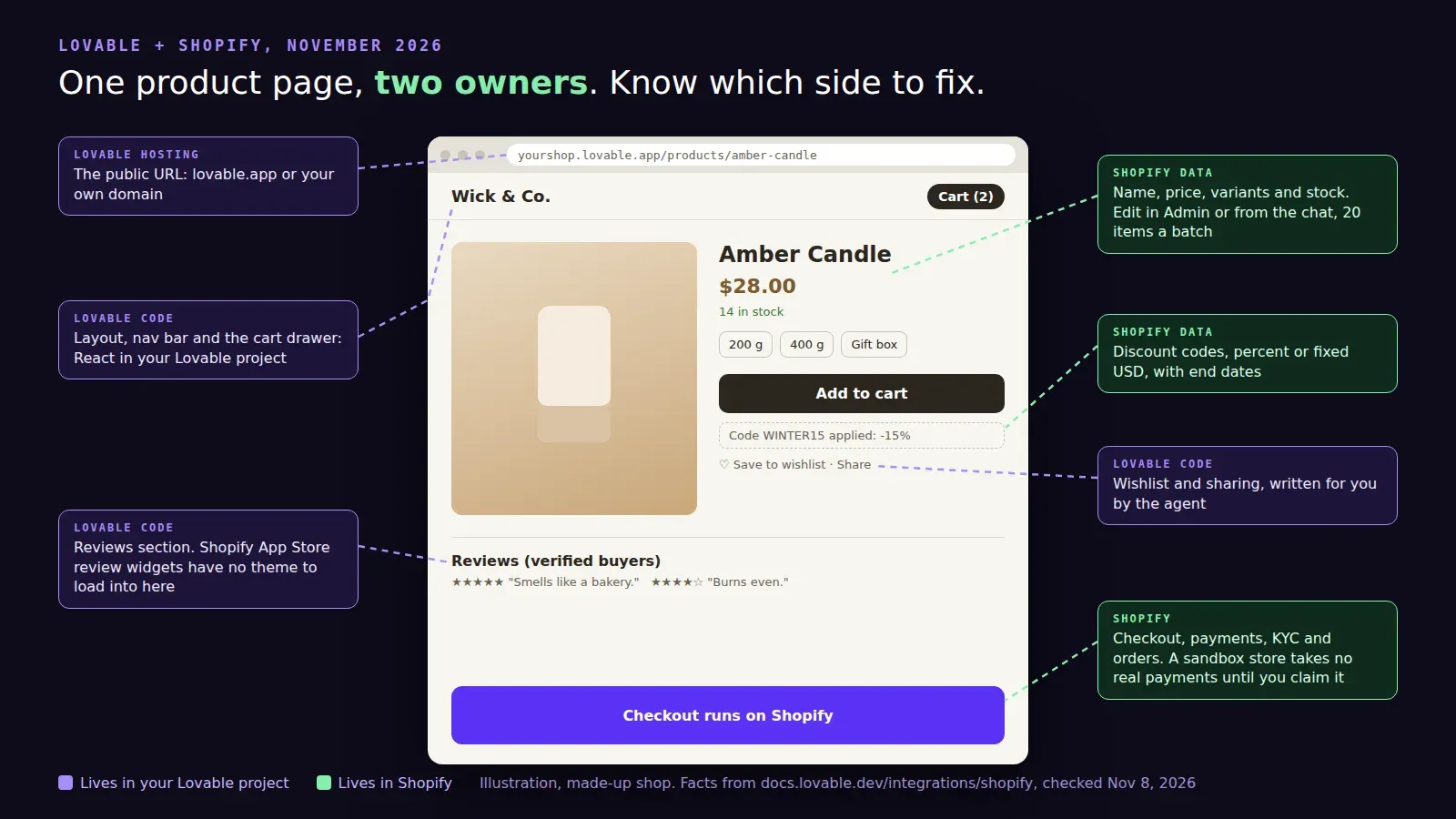
The split matters the day something breaks. Product names, prices, variants, stock and discount codes are Shopify data; change them in Shopify Admin or from the Lovable chat and both sides agree. The product page layout, the cart drawer, the wishlist and the review section are React code in your Lovable project. Lovable can add reviews limited to verified purchases and a shareable wishlist, but those are features it writes for you, not Shopify apps.
Which brings up the thing I’d check before choosing this route at all. Most Shopify App Store add-ons (review widgets, upsell popups, size charts, loyalty badges) plug into Shopify’s own Online Store themes. A Lovable storefront isn’t a Shopify theme. It’s a separate site that reads your catalogue, so those widgets have nowhere to appear. If your plan depends on Judge.me reviews or a specific bundles app showing on product pages, that work has to be rebuilt in code, or you stay on a Shopify theme.
Limits you’ll hit from the chat
The Lovable agent works on products in batches: up to 20 items per batch to create or update products and variants, up to 50 to delete. It runs them one by one, and if item 7 fails, the other 19 still go through and you get a numbered report of what failed. That’s decent. Bulk imports of a 400-product catalogue still belong in Shopify’s own CSV import, not a chat window.
Each collaborator connects their own Shopify account once the store is claimed, and what they can touch depends on their Shopify staff permissions. Sessions last up to 24 hours, then Lovable asks you to reconnect, which is why “it worked yesterday” is the most common Shopify complaint we hear about this setup. A project that was ever connected to Shopify also can’t be remixed until the store is disconnected.
Disconnecting is safe for the store: nothing in Shopify gets deleted. The code is a different story. If your components still point at the old store’s product handles, the pages break quietly, so test every product link after you switch stores.
Google, and the part Lovable doesn’t mention
A Lovable storefront is a JavaScript app that loads products after the page opens. Google can render that, slowly and not always. For a shop that lives on Instagram traffic it hardly matters. For a shop that needs product pages to rank, it’s the first thing to fix, and we wrote up why in Lovable SEO: why Google can’t read your app.
If the store is live, taking real orders, and you need it fast, crawlable and watched by real error alerts, that’s what Lovable to production covers, from $500. Ask us on the contact page if you’re not sure whether to stay on Lovable or move to a Shopify theme. Sometimes the theme is the right answer, and we’ll say so.