Lovable Templates: What a Remix Copies
Lovable templates are ready-made projects you remix into your own copy, on any plan, including Free. The gallery at lovable.dev/templates had 228 of them when I checked on October 30, 2026, sorted into websites and apps, and it calls them “production-ready apps from the Lovable community.” A remix gives you the code and the database structure. It does not give you the data, the secrets, the users, the domain or any of the connections, and that list is where most template-based apps go wrong later.
So a template is a fast start. It’s not a launched app, whatever the gallery header says.
What a remix actually copies
From Lovable’s remix docs and FAQ, checked today.
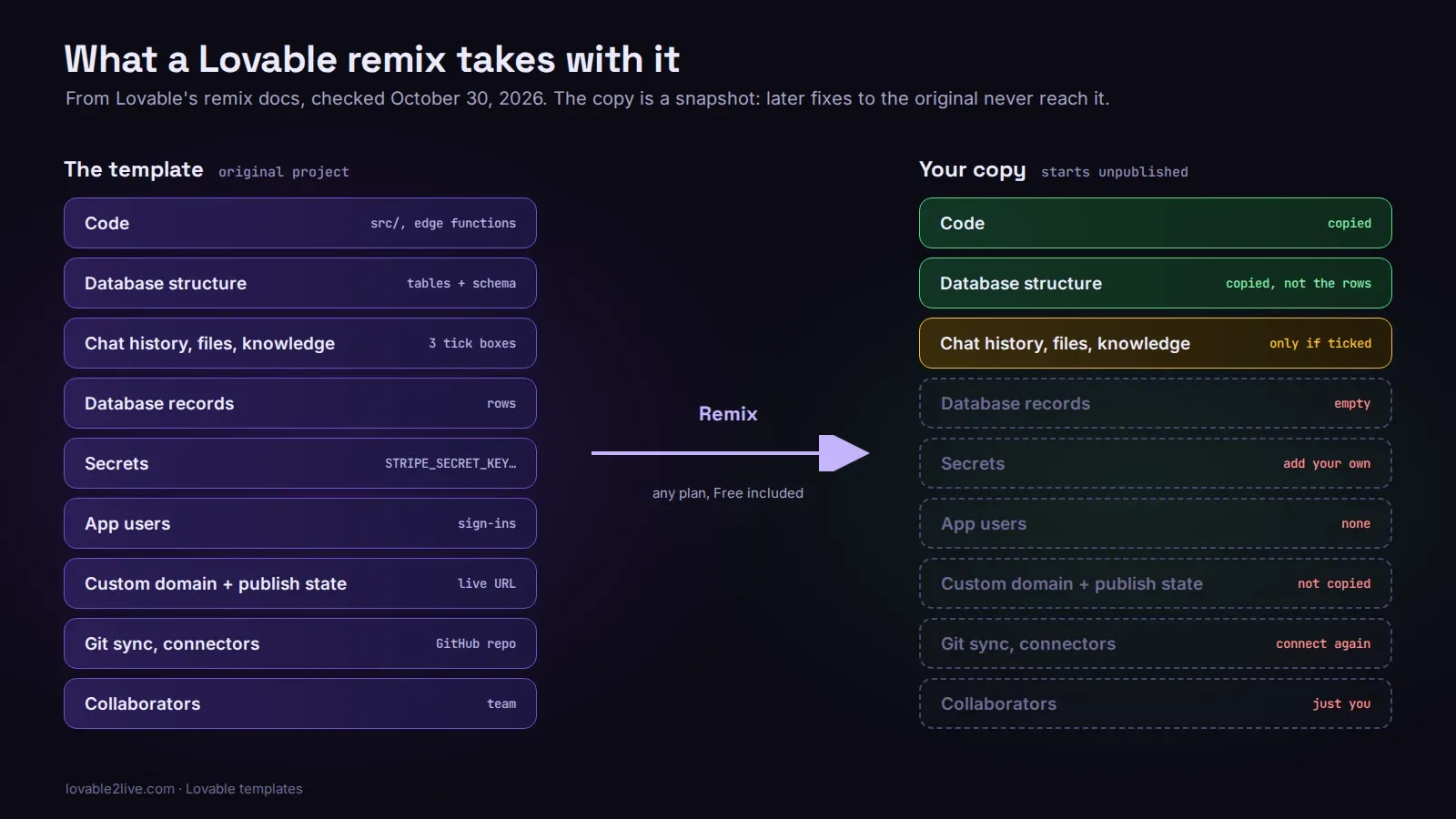
Comes with it: the project’s code, and the database structure (“tables and schema, not the records in them”). Optionally, if you tick the boxes when remixing: the chat history, the Files tab, and the project’s custom knowledge.
Stays behind: database records, secrets, custom domains, the publish state (your copy starts unpublished), collaborators, Git sync and connectors, and the app’s users. Version history too, unless you include project history.
The copy is a snapshot. If the template author fixes a bug next week, you don’t get the fix.
The four things we fix on template apps
We see a fair number of apps that started as a template, and they break in the same places.
Secrets. Any template that talks to Stripe, Resend, OpenAI or anything else with a key is missing that key the moment you remix it. The UI looks perfect, the buttons render, and the edge function behind “Pay now” throws because STRIPE_SECRET_KEY is undefined. One founder had been demoing a remixed booking app to investors for two weeks before trying a real card. The checkout had never worked once. Ten minutes to fix, once someone looked. Add your own keys in the project’s secrets before you test anything that costs money or sends email.
Access rules you didn’t write. The schema comes over, and with it whatever the template’s author decided about who can read which rows. In a single-user demo nobody notices if a table is readable by every signed-in user. In your app with 300 customers, somebody notices. Read every table’s row level security before launch, or have someone do it. Our security audit is $350 and this is the first thing it checks.
The backend region. If the remix runs on Lovable Cloud, the docs say the region is chosen automatically and “can’t be changed afterward.” For most people that’s fine. For a founder in Germany selling to clinics, it isn’t, and finding out after launch means a migration. If data location matters to you, decide before you build on the template: an app on your own Supabase project lets you pick the region, and moving an existing Cloud app there starts at $150.
No Git sync. Service connections don’t carry over, so your remix has no GitHub repo until you connect one. Do it on day one. It’s your backup, it’s how a developer can help you without a Lovable seat, and it’s the only history you’ll have if you skipped “Include project history”.
Remixes that won’t remix
Some projects can’t be copied at all. Lovable’s docs list a few reasons a remix may be blocked: payments enabled on the project, a connected Shopify store, emails sent from the project’s own domain, or the owner having turned public remixing off. Projects connected to an external Supabase project can only be remixed by people with edit access to the source.
That’s why the payment templates in the gallery tend to show the pricing page and the checkout UI without a working payment setup. You wire that part up yourself.
And remember the other direction: if you make your own project remixable, anyone who copies it can read all of its code. Lovable says your chat history and files aren’t shared through the link, but a hardcoded key in a component is.
Is a template worth it?
For a landing page, a portfolio or a waitlist, yes, without much thought. You’ll replace the copy and images and be done.
For an app with accounts and money, a template saves you the first day or two of prompting and costs you nothing extra to start. The docs don’t mention a credit charge for the remix itself, and every change you prompt afterwards costs credits the same as in any project. Just treat the result as someone else’s prototype, because it is. You didn’t write its database rules and you haven’t seen its edge functions, so read them before real users arrive.
That’s the work we do in Lovable to production: a written code audit, then a fixed price from $500, usually 5 to 7 days, and you keep building in Lovable. If you only want to know what the app will cost to run once it has users, the free Lovable cost check reads the repo and tells you.