Lovable vs Bubble: What You Own When You Leave
Lovable vs Bubble looks like a choice between two app builders. It’s really a choice about what you’re left holding in two years. Lovable writes a React and TypeScript codebase that syncs to your GitHub, with a Postgres database you can export. Bubble runs your app on its own engine, and its manual says it plainly: Bubble “generates” code, but “this doesn’t mean you can export this code and run it somewhere else.” Everything else in this comparison is secondary to that.
Prices and quotes below are from lovable.dev/pricing, bubble.io/pricing and the Bubble manual, checked November 2, 2026.
What each one costs, and when the bill grows
| Lovable | Bubble (web) | |
|---|---|---|
| Free | $0, publishing invite-only | $0, 50K workload units a month, no live site |
| First paid plan | Pro $25 a month, 100 credits | Starter $32 a month billed annually, 175K workload units |
| Next | Business $50 a month, SSO, team workspace | Growth $119, then Team $349 (billed annually) |
| What you pay for | Building: credits per AI edit | Running: workload units per database query, workflow and page load |
| Backend | Lovable Cloud billed by usage, or your own Supabase | Included, metered in workload units |
The shapes are opposite. Lovable charges you while you build. Once the app is done and you stop prompting, the credit spend drops, and what’s left is hosting and the Cloud backend. Bubble barely charges you while you build and charges you more as people use the app, because every search and every workflow costs workload units. Bubble emails you at 75% and 100% of your allowance and then bills overages, unless you switch overages off, in which case the app stops doing work.
We had a founder come to us with a Bubble marketplace that was fine at 300 users and on the Team plan at 2,000, mostly because one repeating group ran a search with three nested filters on every page load. The fix in Bubble was restructuring the data. The fix they wanted was to leave. That’s where the second half of this post comes from.
What you can take with you
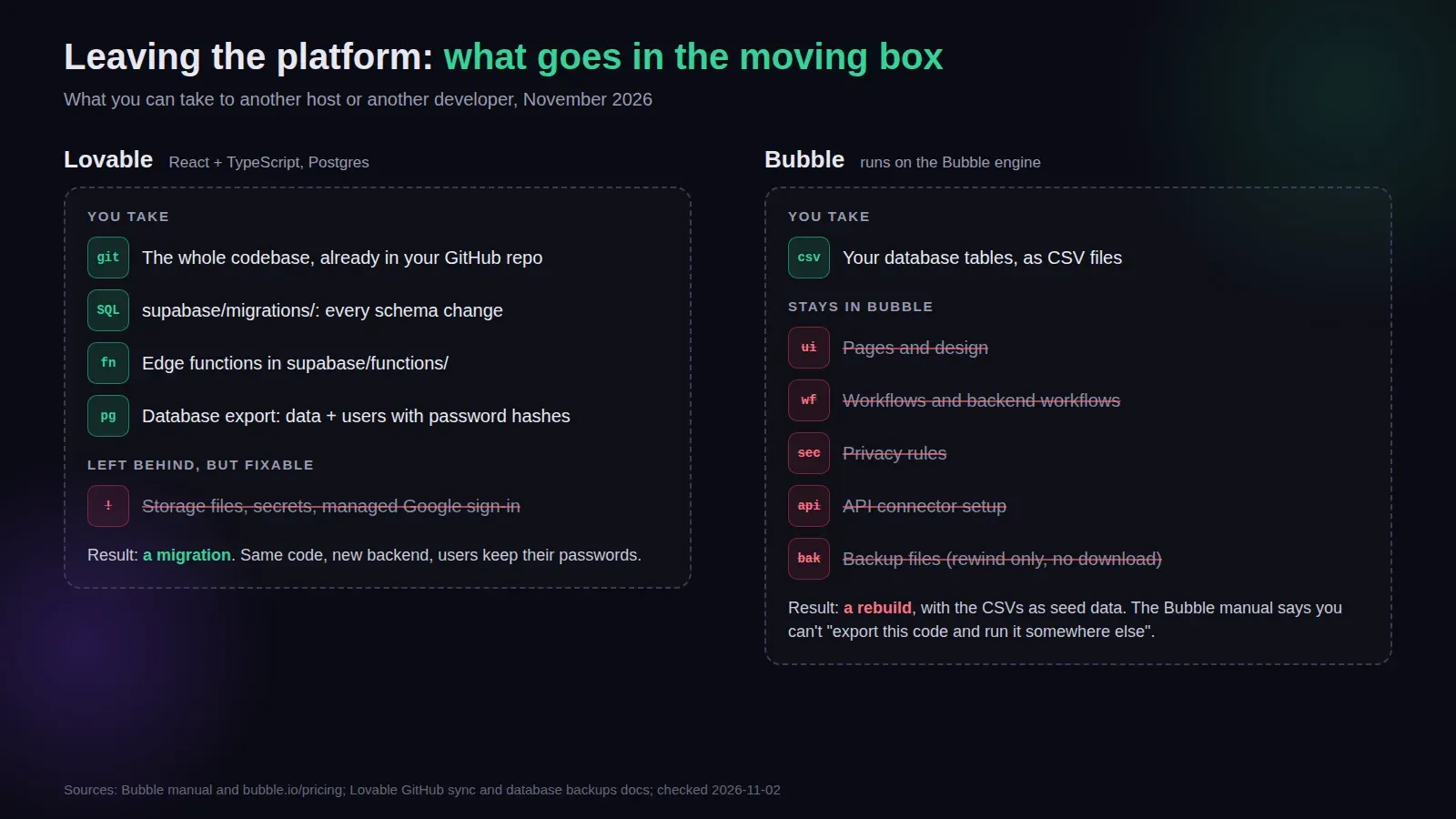
From Lovable, the code is already yours. Every change is a commit in your GitHub repo: React components, the Supabase client, supabase/migrations/ with every schema change, edge functions in supabase/functions/. On Lovable Cloud, the database export gives you a Postgres archive with your data and your users’ password hashes, so a move to your own Supabase keeps everyone’s login working. There are gaps (storage files, secrets, Google sign-in), and we’ve written the full list in our Cloud to Supabase migration checklist. But it’s a migration, not a rewrite.
From Bubble, you get your data. The manual describes exporting tables to CSV, and backups you can rewind to but can’t download as files. The pages, the workflows, the privacy rules and the API connector setup stay in Bubble, because they only exist as Bubble configuration. Leaving means rebuilding the app in something else, with the CSVs as your seed data. The manual doesn’t mention taking password hashes along, so plan as if your users will have to set new passwords.
I’m not saying that to be unfair to Bubble. It’s the deal Bubble offers: the engine does the hard parts, and in exchange your app lives on the engine. For an internal tool or an app you never plan to hand to a developer, that’s a fine deal.
Mobile
Bubble now builds native iOS and Android apps, which run on React Native, inside its own Mobile and Web & Mobile plans. You need a paid plan to deploy a live version, which you need for TestFlight and the stores. The web and mobile apps share one backend, so workload from both counts against the same allowance.
Lovable doesn’t build native mobile apps. It builds a web app. To get it into the App Store you wrap the same code with Capacitor or rebuild the front end in React Native, which is a separate piece of work. We do that at lovable2app.com, and the short version for this comparison is: Bubble is ahead on mobile out of the box, Lovable is ahead on owning what you shipped.
Which one I’d pick
If you’re a non-technical founder building something you expect to hand to developers or investors later, Lovable. A codebase in GitHub is something a developer can read, test and deploy anywhere, and that matters on the day you need someone to fix it. If you’re building an internal tool, a workflow-heavy admin app, or something that has to be in the app stores next month and you don’t want to touch code, Bubble is the more complete product today.
And if you’re already on Lovable and the app has users, the next problems are the boring ones: your own Supabase, backups, monitoring, the security gaps the built-in scan doesn’t catch. That’s what we do in Lovable to production (from $500, 5 to 7 days). If you’re on Lovable Cloud and want out first, Cloud to Supabase starts at $150. Not sure what your app will cost to run once it’s live? The free Lovable cost check reads your repo and tells you.