Lovable vs Claude Code: Which One Fits Your App?
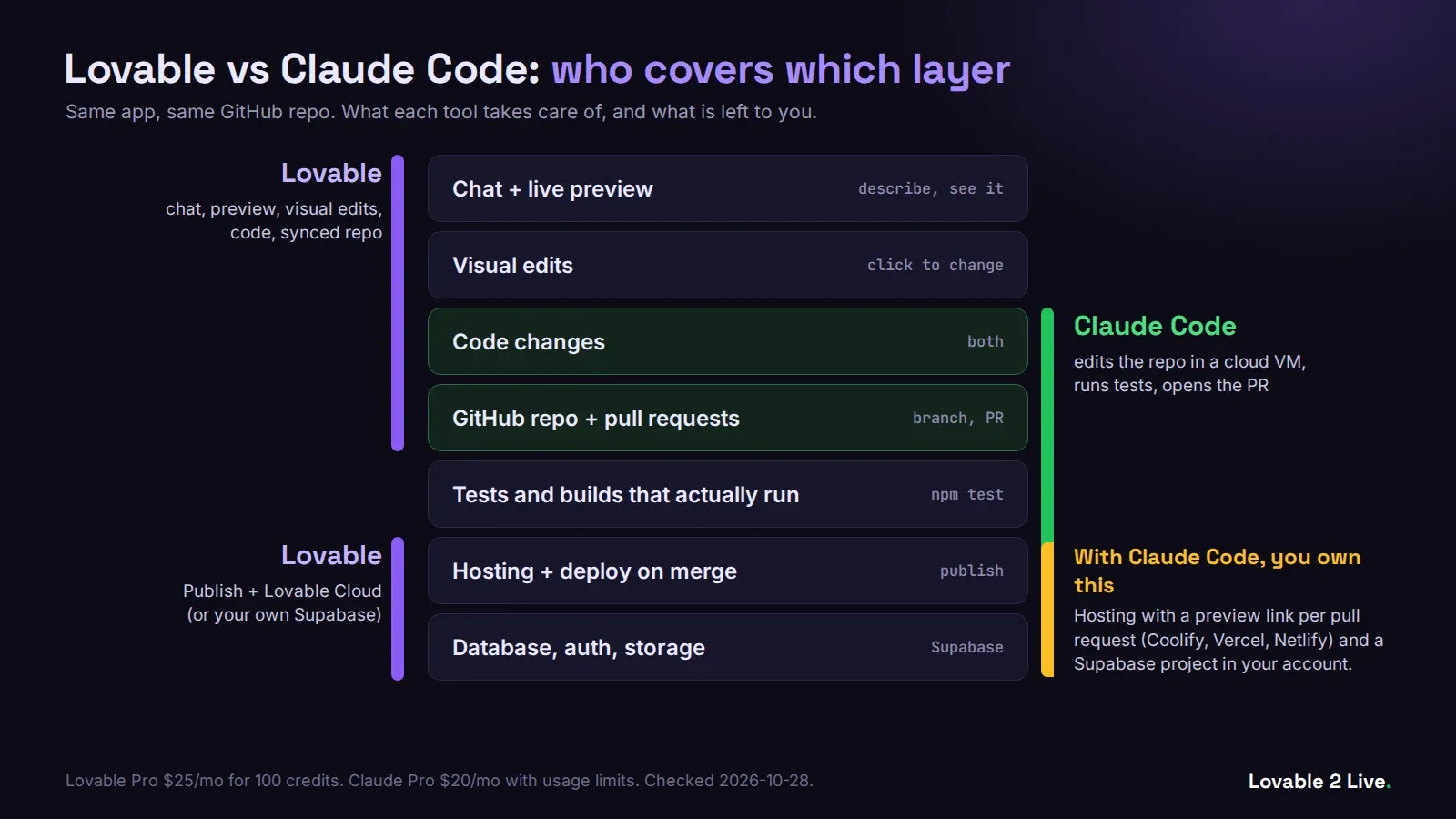
Lovable vs Claude Code isn’t really one tool against another. Lovable is a whole place to build and run an app: the chat, the preview, the hosting and a Supabase backend, all behind one login. Claude Code is a coding agent. It edits a repository and opens a pull request, and everything around that repository is your problem. Which one fits depends far less on how smart the AI is and far more on whether you want to own the rest of the stack.
We checked both on October 28, 2026: Lovable’s pricing page and docs, and the Claude pricing page and the Claude Code cloud sessions docs.
What you pay
Lovable Pro is $25 a month for 100 credits, and top-ups cost $15 per 50, so a credit works out to about $0.30. A message in Plan mode costs 1 credit. In the default mode it depends on the work: Lovable’s own examples run from 0.50 for a style change to 1.70 for a landing page with generated images. Hosting and the backend come out of the same balance once your app outgrows the free monthly Cloud grant.
Claude Pro is $20 a month ($17 on annual billing) and includes Claude Code, in the terminal and in the browser (Claude Code on the web). There’s no per-message price. Instead you get usage limits: a five-hour session window plus weekly limits, and the cloud machine your session runs on doesn’t cost extra. If you hit the limits every day, Max starts at $100 a month.
So for someone who builds a lot, Claude Code is cheaper per change, by a wide margin. But that $20 buys you nothing to run the app on. Add hosting (Cloudflare, Vercel, Netlify, or your own server with Coolify) and a Supabase project, which is free to start and $25 a month on Pro.
What each one actually does
In Lovable you describe a change, it edits the code, and the preview updates in a few seconds. You click Publish and it’s live. You never see a terminal. The backend (database, auth, storage, edge functions) is Supabase, either Lovable Cloud or your own project, and Lovable writes the migrations for you.
Claude Code on the web works like this: you connect GitHub, pick a repo, describe the change, and Claude works in a cloud machine that clones your repo. It can install packages, run your tests and run a build, which is something Lovable’s chat can’t really do for you. When it’s done it pushes a branch and you open a pull request. Then nothing happens until you merge it and something deploys it.
That last sentence is the whole difference for a non-technical founder. With Claude Code you need a deploy pipeline that turns a merged pull request into a live site, and ideally a preview link for every pull request so you can click around before you merge. Coolify does both. Vercel and Netlify do both. Setting it up is a one-time afternoon for a developer and a confusing week for someone who has never seen a build log.
The other thing you lose is the visual editor. Lovable’s Visual Edits let you click a heading and change it. In Claude Code you describe it, wait, and check the preview. Faster for big changes, slower for “make this button blue”.
Where Claude Code wins
Big refactors. Anything across 30 files. Writing tests and actually running them. Upgrading a dependency and fixing what breaks. Lovable can do some of this, but you pay per message and you can’t see the test output, so you end up asking “did that work?” and paying again for the answer.
Claude Code also doesn’t care how your app is built. Lovable is React, Vite, Tailwind and Supabase, and it is very good inside those lines. Claude Code will work on a Next.js app, a Laravel API or a Python worker in the same afternoon.
We had a founder who’d spent close to 400 credits over two weeks trying to get Lovable to fix a date bug in a booking calendar. Timezones, of course. Every fix broke a different week view. A developer with Claude Code wrote 14 tests for the calendar first, ran them, and the agent fixed the bug in one session because it could see which tests failed. The tests are still in the repo.
Where Lovable wins
Starting. Nothing gets you from an idea to a working app with login and a database faster, and the preview loop is great for people who think visually. If you’re still figuring out what the product is, paying per credit is fine. You’re paying for speed, not code.
It’s also one bill and one login. No hosting account, no Supabase dashboard, no environment variables in three places. For a founder that’s worth real money.
Using both on one repo
This is what we see most often now, and it works if you respect one rule: Lovable commits straight to its synced branch and doesn’t open pull requests. Claude Code works on its own branch and opens one. So let Lovable keep main, have Claude Code work on branches, and merge its pull requests into main when you’re not mid-edit in Lovable. Lovable picks up the merged code from GitHub.
Two things bite people. First, don’t edit the same files in Lovable while a Claude Code branch is open, or you’ll get merge conflicts that neither the chat nor you will enjoy. Second, if GitHub offers to delete a branch after a merge, make sure it isn’t the one Lovable syncs to. If it is, Lovable quietly starts committing to a lovable-fallback branch instead. (Our Lovable GitHub sync post has the fix.)
If your app is on Lovable Cloud, the backend can’t follow you to Claude Code without a move: Lovable Cloud’s Supabase project isn’t in your Supabase account, so a coding agent outside Lovable can’t run migrations on it. That’s what our Cloud to Supabase migration is for, from $150, done in 1 to 2 days.
So which one?
Keep Lovable while you’re still shaping the product and you build in short bursts. Move the daily building to Claude Code when your credit spend keeps climbing past the price of Claude Pro plus hosting, when you need tests, or when a developer joins. And put the numbers in before you decide: our free Lovable cost check reads your repo and shows what your bill would be on your own Supabase, on your own server, and with Claude Code on the web instead of Lovable, side by side.
If you want that switch set up once (server, previews on every pull request, the workflow), book a call and we’ll walk through your app.