Lovable vs v0: Where Your Backend Ends Up
Lovable vs v0 looks like a question about which AI writes better React. It mostly isn’t. Both write decent React. The difference that matters a few months later is where your database lives and who owns the account it lives in, and on that point the two tools made opposite choices.
We checked both against their own docs and pricing pages on October 26, 2026. v0’s docs were last updated October 23.
The short version
Lovable gives you a backend inside Lovable: Lovable Cloud, which is Supabase underneath, billed from your Lovable credits. One account, one bill, nothing to set up.
v0 gives you a Next.js app deployed on Vercel, and when you ask for a database it sends you to the Vercel Marketplace. Its databases page lists Upstash, Neon, Supabase and Vercel Blob, and says plainly that adding one “provisions a new user account on that service and adds the necessary environment variables to your project.” So from the first table, the data is in a provider account linked to your Vercel team, not inside v0.
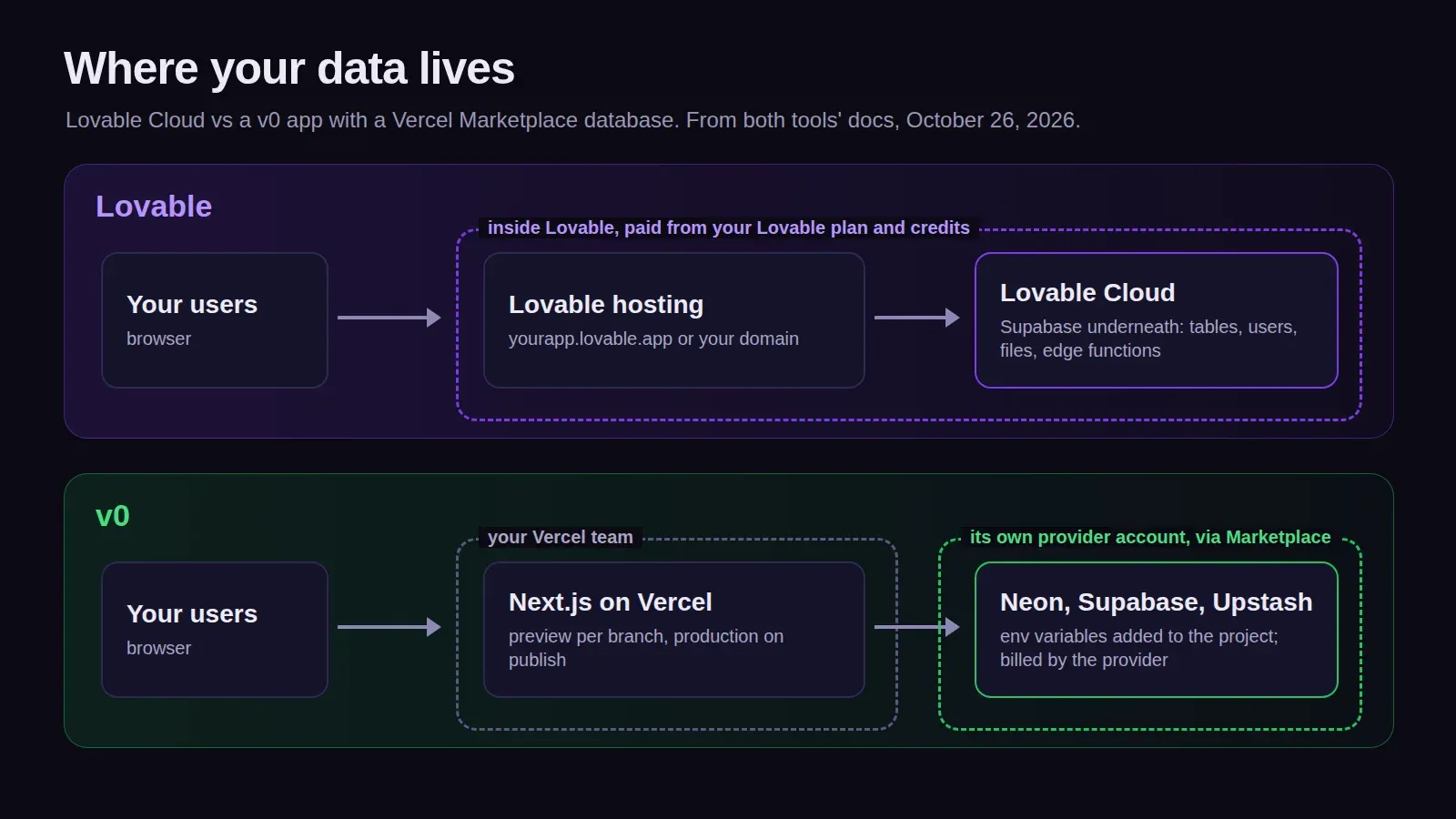
That’s a real point in v0’s favour, and we don’t say it lightly, because moving apps off Lovable Cloud is one of the things we sell. With v0 there’s less to move later.
Pricing, side by side
Lovable Pro is $25 a month for 100 credits plus 5 a day. Since June 1, 2026 those same credits pay for the running app on Lovable Cloud too, and when they hit zero the backend pauses. We broke that down in Lovable pricing.
v0 moved to token billing. On v0’s pricing page Plus is $30 per user per month with $30 of included credits and $2 of free credits a day on login. Business is $100 per user with the same credits plus training opt-out by default. Free is 7 messages a day, and new users get $5 in one-time credits. The old $20 Premium plan is being sunsetted and isn’t open to new users. Messages are priced per token by model: v0 Mini at $0.20 in and $1.20 out per million tokens, v0 Pro at $2 and $10, v0 Max at $5 and $25. Unused monthly credits roll over and expire after 65 days.
The thing that bites people on v0 is input tokens. The pricing docs say each message includes chat history, source files and Vercel-specific context as input. Short prompt, big project, big bill. Lovable bills build messages by the work done (its own examples run from 0.50 credits to recolor a button to 2.00 for a landing page with images), so a small change stays small. On v0 the same one-liner gets more expensive as the codebase grows, because the context it drags along grows.
And note what’s not in v0’s price: hosting, the database and AI calls your app makes are separate Vercel and Marketplace bills. On Lovable they come out of the same credits. Neither is cheaper by default. It depends entirely on traffic, which is why we built a Lovable cost check that reads your repo and works out the Lovable side.
GitHub
Both sync to GitHub, and v0’s flow is more grown-up. A connected v0 chat works on its own branch, gets a preview deployment, and publishes by opening and merging a pull request, with CI checks and branch protection respected (v0 GitHub docs). Once connected, the repository is the source of truth.
Lovable’s GitHub sync is two-way on one branch, normally main, and Lovable commits straight to it. You can switch the synced branch in project settings now, but there’s still no pull request from Lovable to you. It works, and a developer can live with it with a few house rules (we wrote those up in Lovable GitHub sync), but there’s no review step unless you build one yourself.
What each one is actually good at
v0 is very good at UI. It started life as Vercel’s UI generator, it writes Next.js the way Vercel recommends, and if your team already deploys on Vercel, it slots in with no new accounts. The output is a normal Next.js project a developer can take over without learning anything.
Lovable is better for founders who don’t want to touch infrastructure at all. Auth, database, storage, email and edge functions are there from the first prompt, and the app works end to end before you’ve opened a single settings page. That convenience is exactly what makes moving out harder later.
So which one?
If you’re technical, or you’ll hire a developer within a few months, we’d lean v0: Next.js on Vercel and a database in an account you own is a clean place to start, and the PR flow keeps things reviewable.
If you’re a non-technical founder who needs a working product this month, Lovable gets you there faster. Just go in knowing that the backend lives in Lovable’s world. When you get real users or payments, move the database to your own Supabase project; we do that in 1 to 2 days for a fixed price.
And if you already have a Lovable app and you’re tempted to rebuild it in v0 for the cleaner setup: you’d be rebuilding the frontend to fix a backend problem. Move the backend, keep the app. If you’d like a second opinion on that call, get in touch.