Emergent vs Lovable: MongoDB or Postgres?
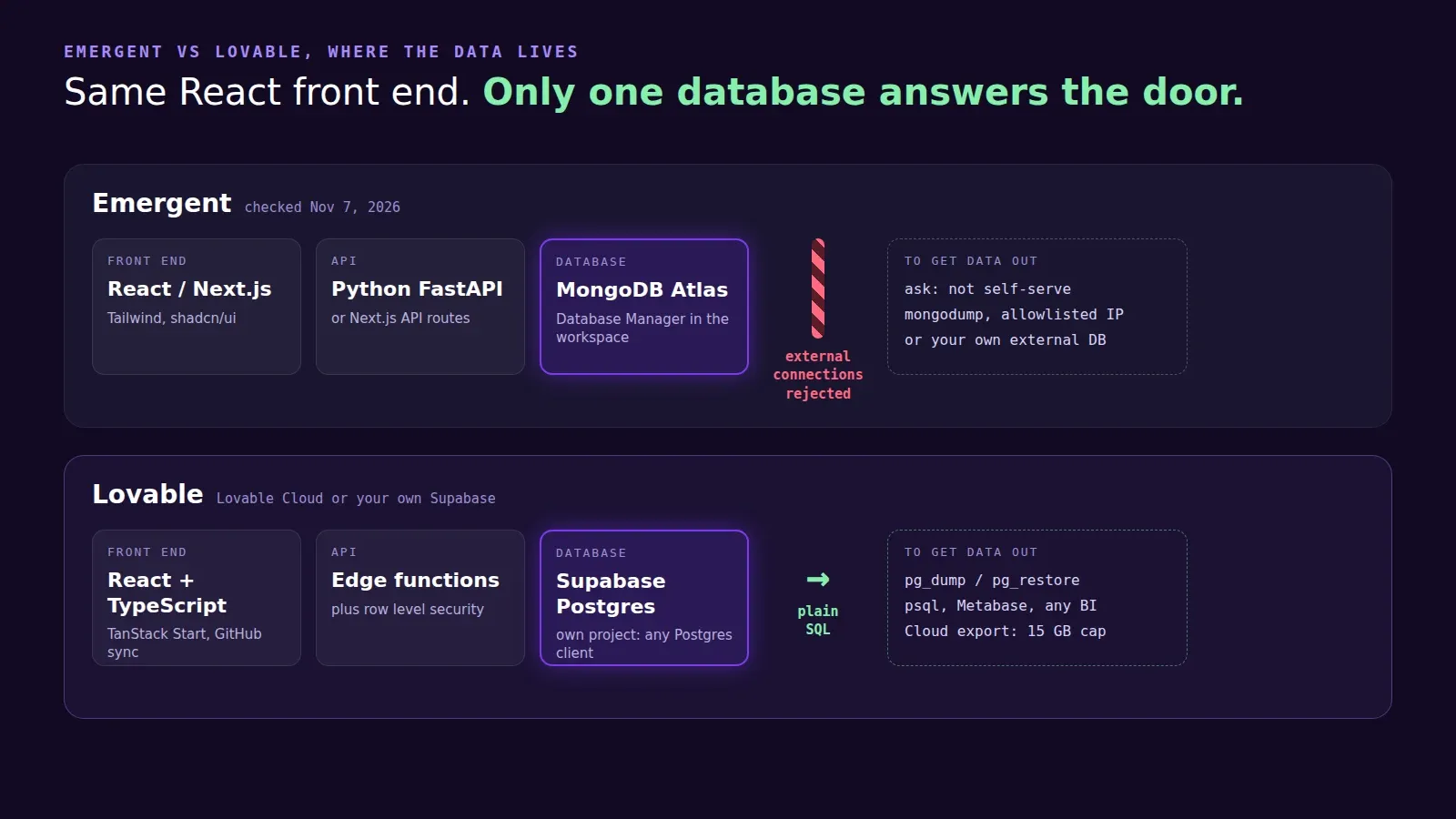
Emergent vs Lovable comes down to the backend. Both take a prompt and build a React front end, both charge in credits, and both host the result for you. Underneath, Emergent writes a Python FastAPI server on a MongoDB Atlas database that only Emergent can connect to, and Lovable writes a TypeScript app on Supabase, which is plain Postgres. That one difference decides how expensive it is to grow the app, hire a developer for it, or leave.
We checked both against their pricing pages and Emergent’s help center on November 7, 2026.
What each one builds
Emergent’s FAQ lists the stack plainly: React or Next.js with Tailwind and shadcn/ui on the front, “Python/FastAPI or Next.js API routes” on the back, MongoDB Atlas for data, hosted on emergent.host behind Cloudflare. Mobile apps are React Native with Expo, built and submitted through Expo’s EAS.
Lovable builds a React and TypeScript app (TanStack Start on new projects), with the backend on Lovable Cloud, which is Supabase run by Lovable, or on your own Supabase project. Auth, storage, edge functions and row level security all come from Supabase. Lovable doesn’t build native mobile apps at all; it builds a web app, and getting that into the stores is a separate job.
Neither stack is bad. FastAPI is a good framework, and plenty of serious products run on MongoDB. The problem is a little narrower than that, and I’ll get to it.
Price, side by side
| Emergent | Lovable | |
|---|---|---|
| Free | 10 credits, can’t publish | 5 credits a day, up to 30 a month |
| Entry paid plan | Standard, $20 a month ($17 yearly), 100 credits | Pro, $25 a month, 100 credits plus 5 a day |
| Next plan | Pro, $200 a month ($167 yearly), 750 credits | Business, $50 a month, 100 credits plus SSO and team controls |
| GitHub | Paid plans, “Save to GitHub” | Two-way sync |
| Running the live app | A publishing tier, minimum 50 credits a month | Paid from the same credits since June 2026, with a 20-credit monthly Cloud grant |
| Unused credits | Subscription credits expire each cycle; top-ups don’t | Monthly credits roll over while you stay subscribed, for up to two months |
The sticker prices are close. The way the bill grows isn’t. On Emergent a published app sits on a tier (Starter, Launch, Grow, Scale, Elite), each with more CPU and memory and its own fixed monthly credit fee, so a busier app means moving tier. On Lovable the running app draws from the same balance you build with, by usage. Both models punish you for not watching the number, in different ways. Emergent’s help center says a published app needs “a minimum of 50 credits to start”, which on Standard is half the month’s allowance before you’ve changed a line.
The database is the real decision
Here is the sentence from Emergent’s FAQ that I’d read twice before starting: “External MongoDB client connections are not supported, the managed cluster rejects external connections.” You manage data through the Database Manager in the workspace. You own the data, Emergent says so clearly, but getting production data out “is not self-serve”: you migrate through your own external database, or mongodump from an allowlisted machine.
So the code leaves easily (push to GitHub, host it anywhere, Emergent says as much), and the data needs a conversation. And when it does leave, it’s a MongoDB dump. If your next developer, your analytics tool, or your next host expects SQL, that’s a schema design job, not a file copy.
Lovable is the opposite shape. Lovable Cloud has its own export limits (databases up to 15 GB, one export every 24 hours, and storage files, edge function code and secrets each move separately), which we covered in the Lovable database post. But it’s Postgres all the way down. Move it to your own Supabase project and you can connect any Postgres client, run pg_dump, point Metabase at it, or take it to RDS later. We moved a small booking app last month whose founder had assumed “my data” meant a CSV download; it was 41 tables, three storage buckets and 2,300 auth users with hashed passwords, and the whole point of doing it properly was keeping those users able to log in the next morning.
One more thing people miss: the backend language decides who you can hire. In our experience a TypeScript app on Supabase is the easiest kind of AI-built app to find help for. A FastAPI plus MongoDB app is fine, but you’re hiring a Python developer for the back and a React developer for the front, or one person who does both.
When Emergent is the better pick
If you need a native mobile app from day one and don’t want a second step, Emergent ships React Native through Expo, and Lovable doesn’t. If your team already writes Python and the app is mostly API work, FastAPI will feel like home. And if you want a 1M-token context and custom agents, that’s Emergent’s $200 Pro plan; Lovable has nothing that maps to it.
When Lovable is the better pick
If the app will hold relational data (users, orders, bookings, anything with joins), if you want to read your own database from outside the builder, or if you think you’ll hand it to a developer within a year, Lovable’s Supabase underneath is worth more than any feature on either pricing page. The mobile gap closes with Capacitor, which wraps the same code; we do that at lovable2app.com.
If you’re on Lovable Cloud already and want the database in your own name, Cloud to Supabase starts at $150 and takes 1 to 2 days. To see what your Lovable app will cost once it has users, run the free Lovable cost check on the repo. And if it works in preview but you don’t trust it with real users yet, that’s Lovable to production, from $500.